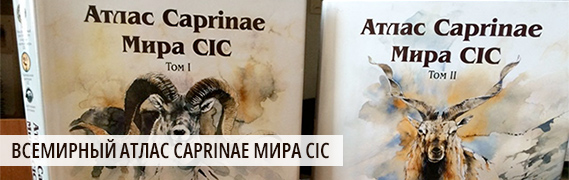


Not long ago we’ve published the article, devoted to Chukotka snow sheep, but we have what to add. We suggest you one more article, wrote by the scientist who studied different subspecies of snow sheep in practice.
The bighorn, chubuk, chubuku, bongga - all these names belong to the the animal dwells in the more severe conditions than where the northern reindeer inhabit.
In 1829 Esholtz described a wild Kamchatka sheep and called it snow sheep. After the nominative Kamchatka subspecies six more subspecies of Asian snow sheep had been described. They all belong to separate big and small geographical populations. There were several more attempts to describe subspecies of snow sheep, fourteen in total, but they were reduced to synonymy because of the lack of persuasiveness of the signs or the infraspecific name.
1. The Putorana snow sheep, Ovis nivicola borealis Severtzov, in 1873, dwell on the Putorana plateau.
2. The Okhotsk or Taigonossky snow sheep, Ovis nivicola alleni Matschie, 1907. At first time that subspecies was described for a Taigonos peninsula but now it spreads on the Priokhotya, Stanovoy, Yablonovy ridges and others.
3. The Yakutia snow sheep, Ovis nivicola lydekkeri Kowarzik, 1913, inhabitats on the Northeastern part of the Verkhoyansky ridge, in 40 miles from the estuary of the river Yana. Those animals inhabitant on the ridges in the center and on the north of Yakutia.
4. The Koryak snow sheep, Ovis nivicola кoriakorum Tchernyavsky,1962, Koryak highland and the upper stream of The Achai-Vayam river.
5. The Chukotka snow sheep, Ovis nivicola tschuktschorum Zheleznov,1990, Anadyr plateau, the Chukotka mountains.
6. The Kodar snow sheep, Ovis nivicola kodarensis Medvedev,1994, the upper stream of The Muskunakh river and The Kodar ridge on the north of Baikal region and on the North East of Irkutsk region.
160 years has passed from the first time when the Asian snow sheep was described to the moment when K. Zheleznov Described Chukchurum (he gave this name to the Chukotka snow sheep).
Chukotka is the unique territory on the end of the Northeastern part of the Asian mainland. The only ungulate inhabitants there is the Chukotka snow sheep. We can hardly believe how those animals survive it those conditions and it makes them the very interesting object to study.
The vertical spread of that population takes the range from the sea level to 1800 masl- on the separate mountain systems. Unlike their southern relatives which dwell on all mountain heights , Chukotka snow sheep prefer to stay on the hills. If they move to the mountains they never climb to the tops and stay in the middle. The upper belt of the local mountains is too severe for them though they are fully adapted to the Polar heights. In fall and winter seasons the slopes located close to the sea, can be covered by ices what means the lack of food for animals who inhabitant there. But it's more plus than minus. The nearness of the sea during the summer time has positive influence on the vegetation on the nearest rocks what is really important for sheep feeding. We mustn't forget about the possibility to eat the seaweed thrown up by the waves. The sea is a huge natural source of salt of those animals. It’s noticed that the snow sheep dwell near the sea, have higher based horns than the animals which inhabitant in areas, remoted from the sea. The horns of young rams look almost like goat horns. It can be caused by the impact of food rich in iodine and other trace elements on the coastal groups of animals.
The short Chukotka summer comes to the end at the beginning of August. The sheep, gained some fat on sparse vegetation, lichens and mushrooms, prepare for cold. The rams which prefer to pasture separately in other time, gather in herds with ewes and lambs. The rut and migration season starts in October, beginning of November. The peak season is in November-December during the Polar night. The researchers say it can last to the end of December and the beginning of January. The rams collide with horns in the flash light of the aurora. The fights intensity correlates with the density of sheep population. The ram’s fights is a rare occurrence if the population density is low. They have nothing to share!
The rams collide with their foreheads at a run. The younger ones stand on their hind legs and beat each other like mountain goats. It’s an ordinary situation when horns of old and even young males are broken, sometimes to a half of them) or scratched off. It's not surprising when the horns of six years old male are longer than the 10 years old ram. The growth of horns decelerates significantly for old animals. They grow in the vegetation period only. It can be just few millimeters for 12-15 years old rams. The winner goes away with 2-3 ewes and in six months, when the blossom season starts, one, much less often, two lambs are born. They grow much faster than the youngsters of Siberian Ibexes. In September the biggest of them are the same size as ewes. They feed on milk till November or even later. It's a survival law in those severe conditions.
The summer food mostly consists on legumes, cereals, sedges, and other herbaceous plants, shrubs, and lichens. I need to say few words about mushroom, there is a phrase, the sheep pick up mushrooms what means that the animals descend to the places where they grow. If there are not sheep on the ridges you have go down to the gorges where they feed mushrooms.
The mineral nutrition of sheep is unique. They eat coal salt shakers and stone " oil " (aluminum-potassium alum), enriched by salts and trace elements of the underlying rocks, to all kinds of loam, tuff, as well as small gravelly minerals with a diverse composition. I guess that only sheep themselves can explain their choice. But they keep silence.
All biological cycle of Chukotka snow sheep - the late birth of lambs, their fast growth and other biological features such as the abrasion of sharp horn’s tips - are the inner subspecies protective mechanism where each detail means a lot to survive is the in the harsh conditions of the extreme northeast of Asia, where any mistake or failure of established biological rules costs the life of the population. This is manifested to the maximum extent on Chukotka.
To taxonomy
The first mentions about Chukotka snow sheep we meet in the literary sources in the second half of 19th century. N.N. Neiman (1871) mentioned them in his historical report about Chukotka expedition. He wrote about numerous flocks near the river Kamennaya (The tributary of the river Orlovka, flows into Bolshoy Anoi). He wrote that they were spread on the territory of all Chukotka and reached the shores of Arctic Ocean.
We can find more interesting details in the esse of another famous researcher of the northern lands L.A . Portenko. He was an ornithologist. He's listed the herds; they've seen and their numbers and there we can read the next data. “October 3rd, We met several rams of different age on the Left Keralgaum river... Same day we met one more old ram. It was bigger than the ordinary Chukotka deer and had huge curled horns”. Probably they are the first but not proved data about huge size of Chukotka snow sheep what influenced the researchers at the end of XX century.
All date, collected later by other people were generalized by the well-known researcher of bovidae animals the Academician V.I. Tsalkin in his famous work "Mountain sheep of Europe and Asia" (1951). He described four subspecies of snow sheep (Kamchatka, Taigonossky or Okhotsk, Yakutia, and Norilsk or Putorana snow sheep). He wrote about the Chukotka snow sheep: “The systematic position of sheep from the Anadyr region is still not clear. The only sample from that place is in the collection of Zoological museums of MSU. The bone rods of the horns and the horns themselves are close to the samples from the North of Yakutia. Unfortunately, It has no skin and we can't judge about its color. We can’t find its description in the modern literature too. That’s the reason why we can't close the question about the systematic position of Anadyr sheep now. But they are close to Yakutia subspecies or even can be identified with it”. The authority of that scientist was so high That almost all authors referred Chukotka snow sheep to Yakutia subspecies without any doubt.
In 1984 one more work had been published. It belonged to F.B. Chernayvsky and was called “ The Mammals of the extreme north-east of Siberia”, where he analyzed all the morphological material and came to the conclusion: “... Snow sheep inhabitant on Chukotka has an identity at the subspecies level» He was realizing the lack of material to make the full analysis of the Asian snow sheep species (Ovisnivicola) and had proposed to accept "tentatively" 5 subspecies, "inhabiting the north-east of Siberia and Kamchatka” while collecting the missing materials.
N.K. Zheleznov in 1990 and later in 1994 published in his works "Wild ungulates of the North-East of the USSR» and "Ecology of snow sheep of Northern Asia» The description of new subspecies of snow sheep from Chukotka peninsula as Ovisnivicolatschuktschorum.
The systematic observations Zheleznov considered Chukotka snow sheep to be the biggest representatives among other subspecies of the Asian snow sheep, including Kamchatka snow sheep and Kodar snow sheep. The researchers of the last one showed the presence of big individuals. This is especially showed in females. Their maximum size is much bigger then the ewes from other populations of Koryak, Putorana, Okhotsk and Yakutia snow sheep. They are approximately the same size as rams of Kamchatka snow sheep. But the scull of these animals and especially rams is smaller by size and width and can be compared by these features with the representatives of other geographical populations of snow sheep. The other craniological characteristics except the size of the scull are absent.
At last the time to make the genetic analysis of the Asian snow sheep to confirm or refute the systematic status of subspecies, has came. The author of that article together with other scientists has managed to collect the material to make the genetic analysis of large geographical population of Asian snow sheep including Chukotka populations.
We’ve analyzed about 40 samples taken from 40 individuals of snow sheep to define a persistent difference between the Asian and American groups of these animals. It’s improperly to call Asian snow sheep canadensis or Canadian snow sheep. Everything is more difficult inside the Asian group.
The scientists came to the conclusion about the genetic affinity of Asian snow sheep what was grounded by morphologists before. Many of morphological features of separate large geographical populations, including Chukotka one, are in the limits of variability and don’t reach the real subspecies differentiation. The genetic analysis (I need to note that we didn't have a large amount of material for research) confirmed this vision. It's happened that two groups distinguish inside the areal of Asian snow sheep - snow sheep of Kamchatka and Koryak highland and another group is animals, dwell on Putorana, Kodar ridges, Yakutia, including the Stanovoy ridge, Okhotks mountains and Chukotka peninsula.
We collected the samples of snow sheep specimen, including the ones taken during our own research expeditions, which are listed in the researched basis of such geographical population as Kodar region (the river Apsat and Srednyi Sakukan), Kamchatka ((Cape Nalycheva and other territories), Koryak (the northern part of the Koryak highlands on the border with Chukotka), and Chukotka (the Chukotka peninsula- the Anadyr Highlands). The last sample was delivered by students, game-biologists, who found the fresh remains of local snow sheep, killed by wolves on the salt flats.
There are two points of view on the taxonomic position of the snow sheep of the Chukchi Peninsula. Some scientists think like N.K. Zheleznov- Chukotsky, who described that subspecies, that those animals belong to the differentiated subspecies.Their size, especially ewes, is bigger then in other sheep populations. F.B. Chernayvsky was the first who mentioned it. The adherents stand that Chukotka snow sheep is small and their horns are not thick enough in the base. They inferior in that feature to the sheep from other geographical populations.
I talked with the researchers who often visit Chukotka (Maksim Vorobiev - the owner of “Russian Professional hunters” company helped me very much) and made to the conclusion: Chukotka snow sheep has lighter color than the relatives from Koryak and Kamchatka. They d interior in the horn and body sizes to Kamchatka sheep but remind the samples from Koryak highland.
In 2000 I took part in the expedition of ISHA, lead by the President of this organization Joe Quarto. It took place on the Apuka river. Before it, all studies were conducted in the upper reaches of the river.
Pahachi. We got several males of Koryak sheep in the frame of the scientific program. I measured two rams of the snow sheep, we got. They superior di in size the ones, described by F.B. Chernyavsky. But not much. But we detected the rams that were bigger than the ones we hunted and got.
it is necessary to mention three ecological rules that reflect the essence of the adaptation of mammals to changing geographical conditions of the environment.
Chukotka snow sheep, according the Gloger rule, have to have lighter color than the other sheep because inhabitant in more severe, northern territories. Many authors agree with that fact and there are no disputes. According to the Allen’s rule, Chukotka snow sheep , as well as sheep from other Asian territories, should have relatively short muzzles and ears. It is not disputed by researchers. As for the huge body size, described by N.K. Zheleznov-Chukotky. They correspond to the Bergman rule – when moving from the equator to the poles, warm-blooded land animals increase their size, reducing heat transfer. A small rodent or shrew (with increased heat transfer per unit area of the body) freezes, falling into an earthen pit in the summer, But a large and perfectly adapted animal like the snow sheep is able to remain viable in the harshest winter conditions of the northern mountains beyond the Arctic circle during the long periods of bad weather and lack of food.
It's not clear how it connects with the fact that animals from the northern population of Koryak snow sheep are the smallest and the rams from the south population of Kamchatka snow sheep are bigger.
There are still many questions, and further research is needed to resolve them.
It’d be interesting to practice the new kind of hunting tourism when the trophy is the picture and video of the trophy. The hunters can use the special methodology to estimate the trophy and to rank its horns. The suggested variant of photo and video tourism will allow alternate between the work of security cameras set by the conductor and the client and filming with a manual camera with a telephoto lens and a tripod from a long distance. The perspectives of that kind of tourism are in the price of trips and the period duration that lasts - from the spring to the late fall.
Have all genetic research regarding subspecies of the Asian snow sheep finished? I think no. In science, as in life, there is always room for improving methods and assessments. The study of the Chukchi snow sheep would answer many questions. In conclusion I want to say that such large population as Chukotka snow sheep is needed the special protection strategy which has to include the following points:
1. The periodic conducting of an aerial survey allows to give a qualitative and quantitative assessment of populations-at least once every 5 years.
2. Ground-based annual animal registration, including the organization of the collection of survey data, to assess the state of populations.
3. The permanent monitoring (non-contact on the part of a person) with the installation of automatic cameras in key habitats: Cameras that allow to track animals all year round.
4. The development of tourism on the base of all year-round monitoring.
5. Organization of semi-voluntary aviary breeding of animals at the stage of scientific experiment and study of their biology
6. If the experiment will be successful, the scientists can think about the animal breeding to replenish natural populations.
7. The reservation and study not only animals but the biocenoses within their range.
8. The estimation of population and separate animals cost.
9. Determination of damage caused to the particular population by humans.
The compliance with this strategy would help to restore the number of the Chukotka snow sheep and turn it from the "Red book" to a commercial species.